Repression Refers to the Defense Mechanism by Which People
Repression is a defense mechanism in which people push difficult or unacceptable thoughts out of conscious awareness. Repressed memories were a cornerstone of Freud s psychoanalytic framework.

Defense Mechanisms
Often involving sexual or aggressive urges or painful childhood memories these unwanted mental contents are pushed into the unconscious mind.
. The maneuvers are known collectively as defense mechanisms. Psychologists interpreted the idea as forgetting painful memories. Regression is nothing but unconsciously reverting back to in terms of thoughts feelings behaviours an earlier stage of development.
Repression which Anna Freud also called motivated forgetting is just that. Repressed memories were a cornerstone of Freud s psychoanalytic framework. Repression refers to the defense mechanisms by which people _____ threatening impulses by attributing them to others.
This is the fundamental defense mechanism in Freudian theory. People usually regress when they find it difficult to address their issues in an age-appropriate manner or when they. Repression is commonly known as being defensive.
Here the individual suppresses his or her thoughts or feelings. These mechanisms are referred to as unconscious defense mechanism or ego defense mechanisms Repression. Repression in psychoanalytic theory the exclusion of distressing memories thoughts or feelings from the conscious mind.
As much as our body can restore itself back to normal state when we suffered physical wound it also has defenses against emotional wounds and shock. What is Repression. Not being able to recall a threatening situation person or event.
If repression threatened to fail Freud suggested a person would perform mental maneuvers to avoid confronting an unacceptable thought or action. Repression refers to the defense mechanism wherein people remove uncomfortable events to inaccessible areas of the unconscious mind. For example an individual fixated at an earlier developmental stage might cry or sulk upon hearing unpleasant news.
Neo-freudian theorists are most likely to disagree about. Repression is a defense mechanism that involves pushing threatening impulses out of conscious. Repression refers to the defense mechanisms by which people banish threatening impulses by attributing them to others.
Primitive Defense Mechanisms. Repression is thought to give rise to anxiety and to neurotic symptoms which begin when a forbidden drive. Repression refers to the conscious or unconscious negation of stressful emotions that might cause anxiety Freud 1937.
This is also a defense mechanism that is quite common. The concept of repression changed after Freuds death. Repression occurs when a thought memory or feeling is too painful for an individual so the person unconsciously pushes the information out of consciousness and becomes unaware of its existence.
Repression is a central concept in classical psychoanalysis and provides the basis for explaining psychopathology in. It is a defense mechanism that is used to deal with the current stressors of our lives. This allows the person to restrain the memory from conscious awareness.
What you forget cant hurt you. Correspondingly what is undoing defense mechanism. This can be defined as deliberately pushing away the uncomfortable hoping they will disappear or be able to be dealt with at another time.
Repression is a defense mechanism in which people push difficult or unacceptable thoughts out of conscious awareness. This indicates that the test has little validity. Up to 10 cash back Definition.
In psychology repression is considered as a defense mechanism that reduces the anxiety that the person feels. Through repression the individual can suppress an unwanted or undesirable emotion or. Repressing is like the diminishing of a bad memory that a person does not want to remember because it might be abusive or traumatic.
The defense mechanisms by which people disguise threatening impulses by attributing them to others is called. The development of detrimental behaviors that distract attention and energy away from other stressors. Repression is a defense mechanism that involves pushing threatening impulses out of conscious awareness.
Repression refers to the act of bringing under control by force. When a situation is too overwhelming or painful for an individual the individual tries to repress this event. Repression is a defense mechanism whereby unpleasure-provoking mental processes such as morally disagreeable impulses and painful memories are actively prevented from entering conscious awareness.
47 Repression refers to the defense mechanism by which people offer self-justifying explanations in place of the real but threatening unconscious reasons for actionIncorrect retreat to behavior patterns characteristic of a more infantile stage of developmentIncorrect. Freud suggested that defense mechanism protect an individual from anxiety repression refers to the defense mechanism by which people banish anxiety arousing thoughts from consciousness rorschach inkblot test results diagnose many normal adults as disordered. Repression is an unconscious defense mechanism employed by the ego to keep disturbing or threatening thoughts from becoming conscious.
We all do it. Anna Freud called this defense mechanism regression suggesting that people act out behaviors from the stage of psychosexual development in which they are fixated. This is when a person has a complete memory loss of a painful event.
This defense mechanism may be present in conduct disorder antisocial personality disorder. Repression is restraining thoughts or emotions.
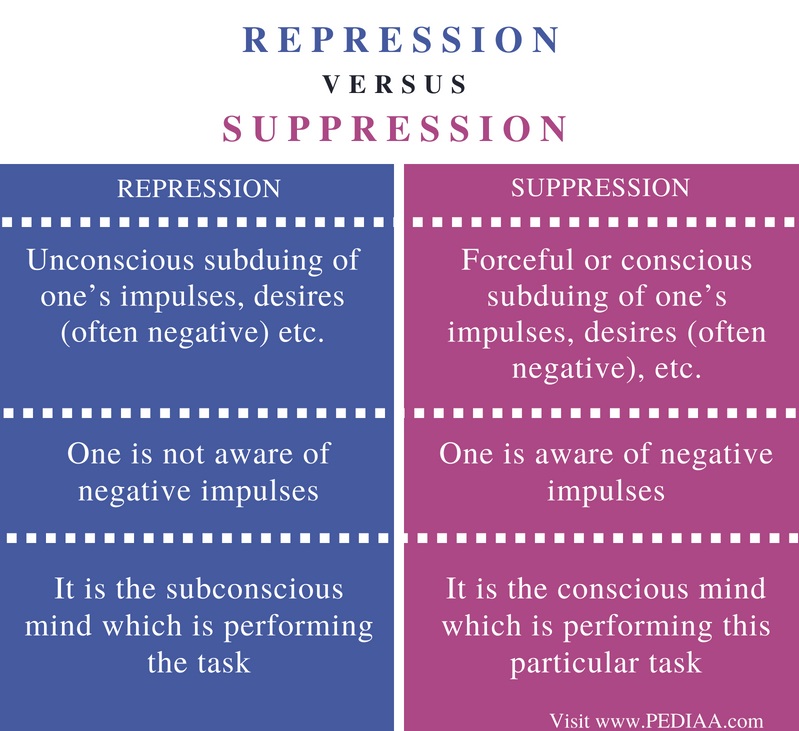
Difference Between Repression And Suppression Pediaa Com

Defense Mechanisms Simply Psychology

Repression Defense Transmutation And Targeting Emotions Download Table
No comments for "Repression Refers to the Defense Mechanism by Which People"
Post a Comment